VERY CURRENCY.
Dogecoin launched on 6 December 2013 with an identity inspired by the Kabosu-based Doge meme.
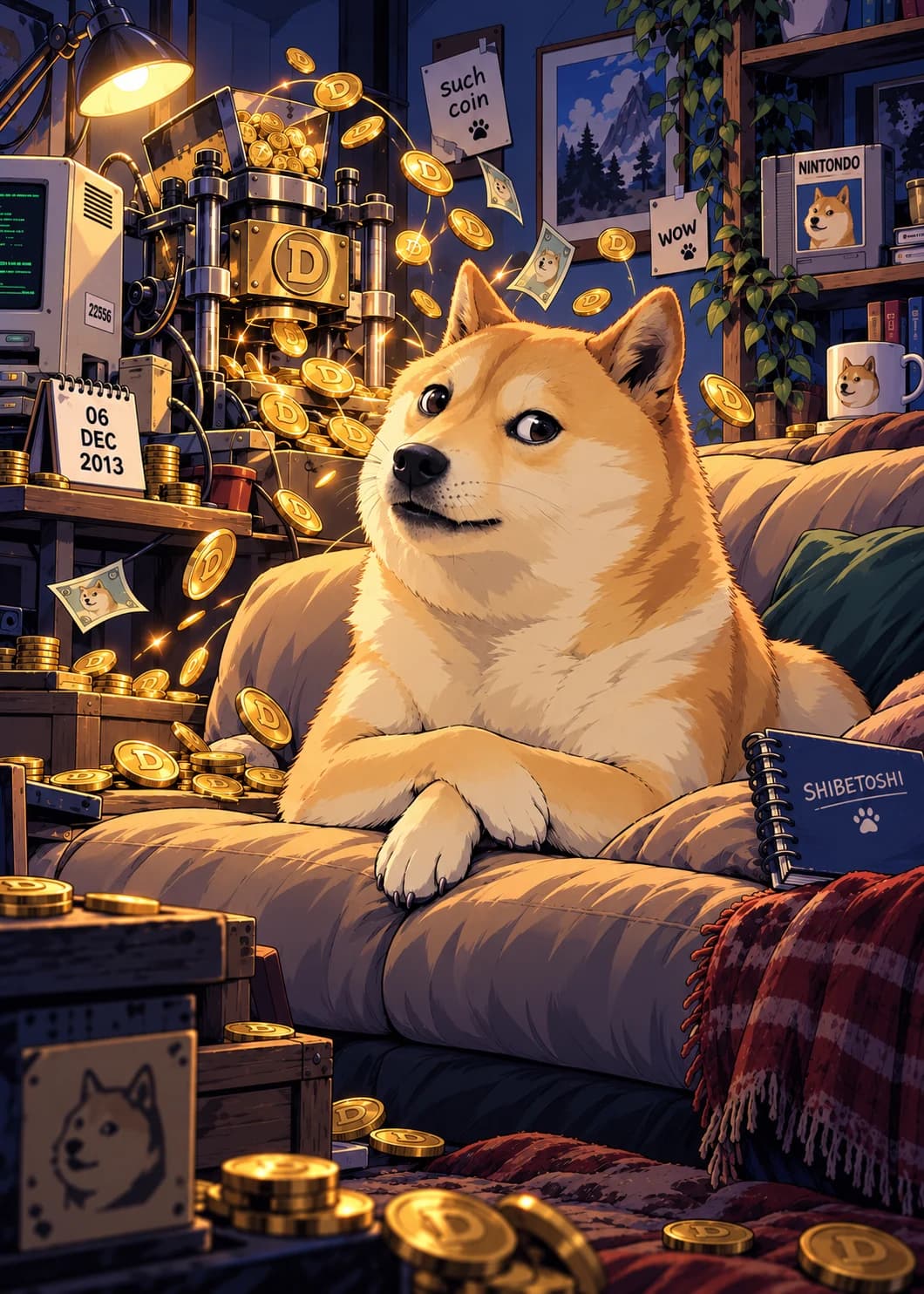
Kabosu sits with her paws crossed while a homemade mint showers the room with golden coins. The machinery is busy; its apparent owner seems much less concerned. Notes, a game cartridge and a notebook turn the room into a miniature world built around the same face. The scene is imaginary, but its mixture of technology and cheerful absurdity belongs to Dogecoin’s story.
Dogecoin launched on 6 December 2013, created by Billy Markus and Jackson Palmer. It borrowed its identity from the Doge meme, whose familiar expression came from a 2010 photograph of Kabosu, a Japanese Shiba Inu. Palmer built the website, while Markus developed the early software. A joke about cryptocurrency’s seriousness had become a cryptocurrency people could actually use.
The joke gave people a shared language. Dogecoin found an enthusiastic audience on sites such as Reddit, where small tips became part of its community culture. The card keeps VERY CURRENCY., wording preserved in its early announcement thread. Its deliberately awkward language fits the dog’s expression: an invitation to take part in something cheerful and slightly ridiculous.
The physical coins are a visual metaphor, not a claim that a real mint made Dogecoin. Behind them, quieter details point to the software and people involved: an oddly spelled cartridge, a developer’s alias and a network port number. The calendar anchors everything to the launch. A familiar internet face sits at the centre of a new kind of shared enthusiasm.
Sources & the artist’s interpretation
Dogecoin’s official history supplies the launch and meme background. Dogecoin Core supplies Nintondo and port 22556; the announcement thread preserves the phrase. The thread’s opening post was later edited. The artwork interprets Kabosu’s likeness in an invented room; its physical props and coin-making machine are metaphors.