50 TO 25.
Bitcoin’s first halving on 28 November 2012 reduced the block subsidy from 50 to 25 BTC.
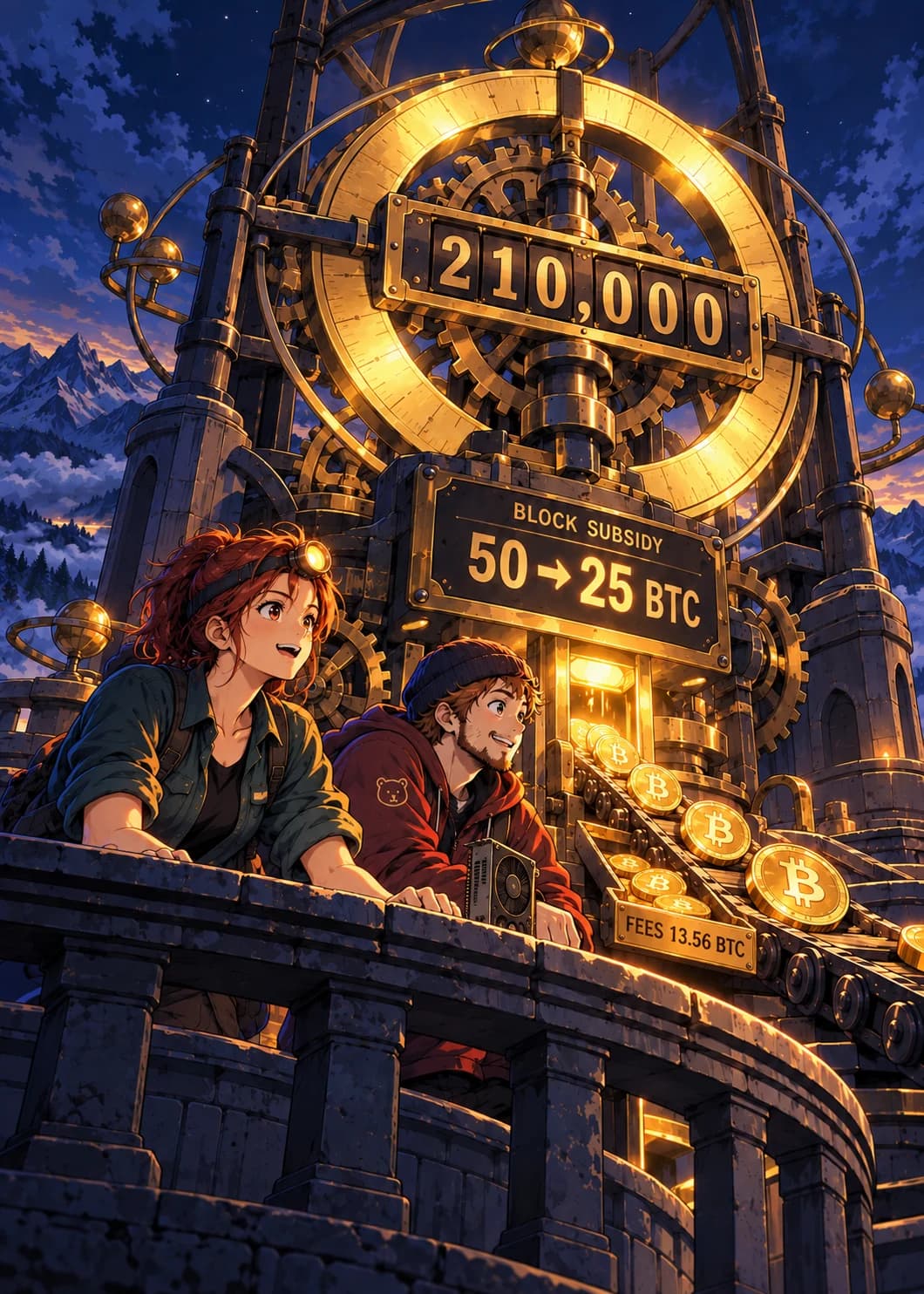
High above an imagined mountain valley, an enormous clockwork ring turns to 210,000. The two miners at its railing watch a reward mechanism change from 50 to 25 BTC. The setting is a metaphor: no such observatory controlled Bitcoin, and no one pulled a lever to make the network obey the rule.
On 28 November 2012, block 210,000 activated Bitcoin's first scheduled halving. The new bitcoins allowed in each block's subsidy fell from 50 to 25. Coins people already held were not cut in half. The following blocks carried on, and miners could still earn transaction fees on top of the newly reduced subsidy.
The milestone block came from Slush's Pool, whose earlier cooperative-mining moment appears on card 011. Slush wrote at the time that a newer pool member, known as "laughingbear," had found it while mining with an ordinary GPU. Here the returning red-haired miner from card 011 and the beanie-wearing figure with a small bear patch stand in for a wider community, not a documented meeting or verified portraits of those people.
That block's fees were unusually striking: 13.56295554 BTC, besides the 25 BTC newly issued as subsidy. In the artwork, a little side tray keeps them separate while the linked belt rolls on. The clock's drama is not a crash or a coin being cleaved; it is a prearranged rule taking effect and the network continuing afterward.
Sources & the artist’s interpretation
Bitcoin.org's halving history records 28 November 2012, block 210,000 and the 25 BTC subsidy. The contemporary block discussion records the block's details and Slush's confirmation that his pool found it; Slush's contemporary post identifies the pool member and ordinary GPU. The block record reports 13.56295554 BTC fees and 25 BTC newly minted. The observatory, character gathering, recurring fictional miner, bear patch, clock and belt are art, not historical documentation. No real person's likeness is claimed.