THESE TURNED OUT SWEET!
Mike Caldwell launched Casascius physical bitcoins in September 2011 with private keys concealed inside the coins.
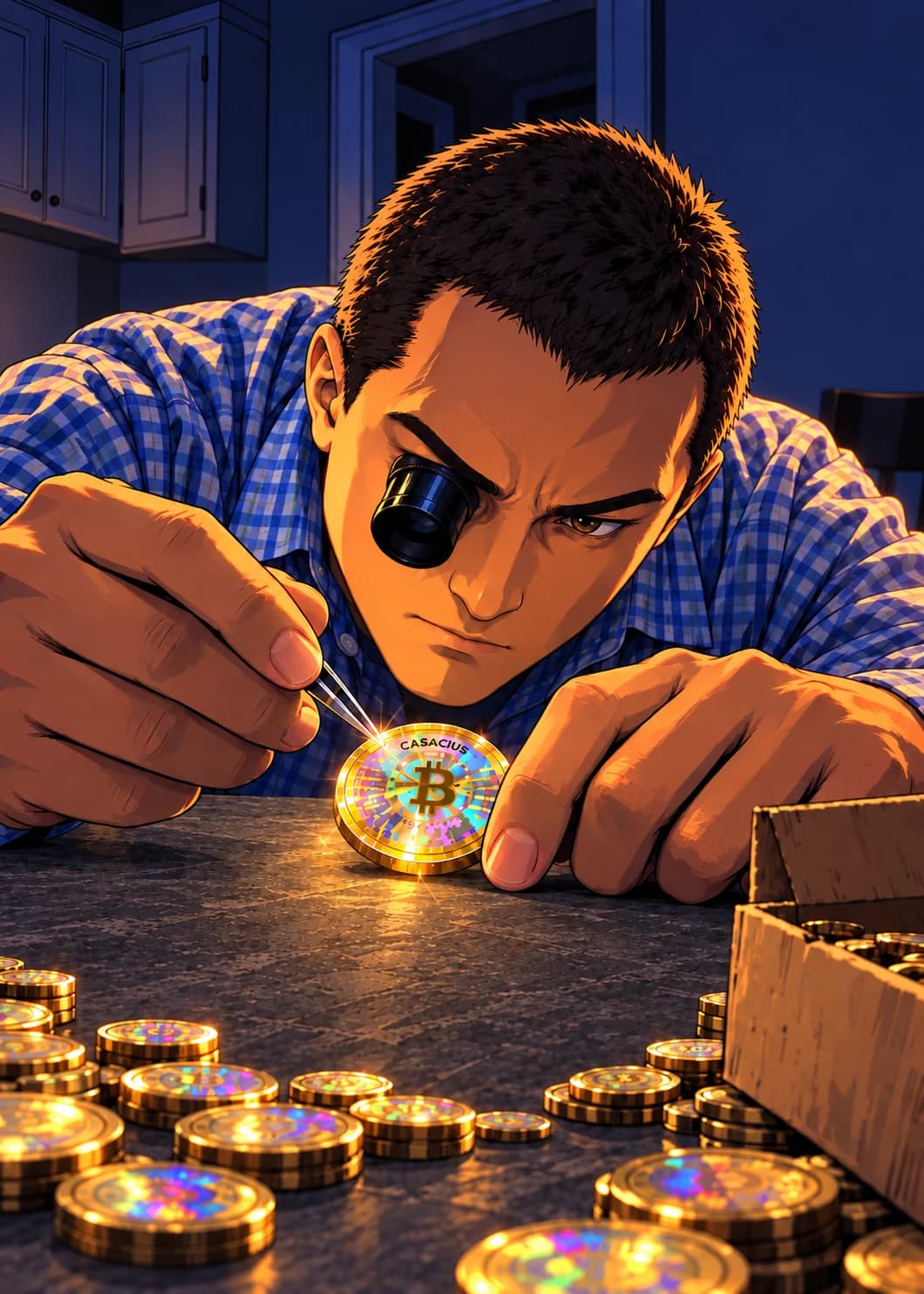
At a kitchen table, Mike Caldwell leans over a brass coin and carefully touches its hologram with tweezers. The scene is an illustrated reconstruction inspired by later photographs of Mike handling Casascius coins at home; it is not a photograph of the first coin being made.
On 6 September 2011, Caldwell offered Casascius physical bitcoins on the Bitcoin forum. His launch post described a one-bitcoin coin with a hologram on one side, a private key beneath it, and the first eight characters of its Bitcoin address visible. He wrote, “These turned out sweet!” It was a way to make an unfamiliar digital system something a person could hold and give to someone else.
The coin did not contain a tiny piece of the blockchain. The Bitcoin balance belonged to an address on the network. The concealed private key allowed its holder to move that balance, while the public address prefix offered a way to check it. The tamper-evident hologram mattered because peeling it to reach the key would leave evidence that the seal had been disturbed. A recipient also had to trust that the maker had not kept a copy of the key.
Caldwell later described the project as a proof of concept and a conversation piece. Collectors found meaning in the object itself. This quiet, manual scene captures the unlikely leap: electronic cash becoming a coin, and a coin becoming part of Bitcoin history.
Sources & the artist’s interpretation
Caldwell's 6 September 2011 launch post supplies the date, phrase and original coin description. The Casascius FAQ records his motivation, the original-series typo and the tamper-evident seal. His Statement of Controls describes the key-handling and hologram process. The user-supplied later photographs informed the home setting and checked shirt. The illustration is a dramatized reconstruction, not documentary evidence of the 2011 launch.